SAGIPfarmer is a solar-powered IoT system that reads your rice field's water level and soil moisture in real time — and sends it straight to your Android phone. Know exactly when to irrigate, when to drain, and when to save water.
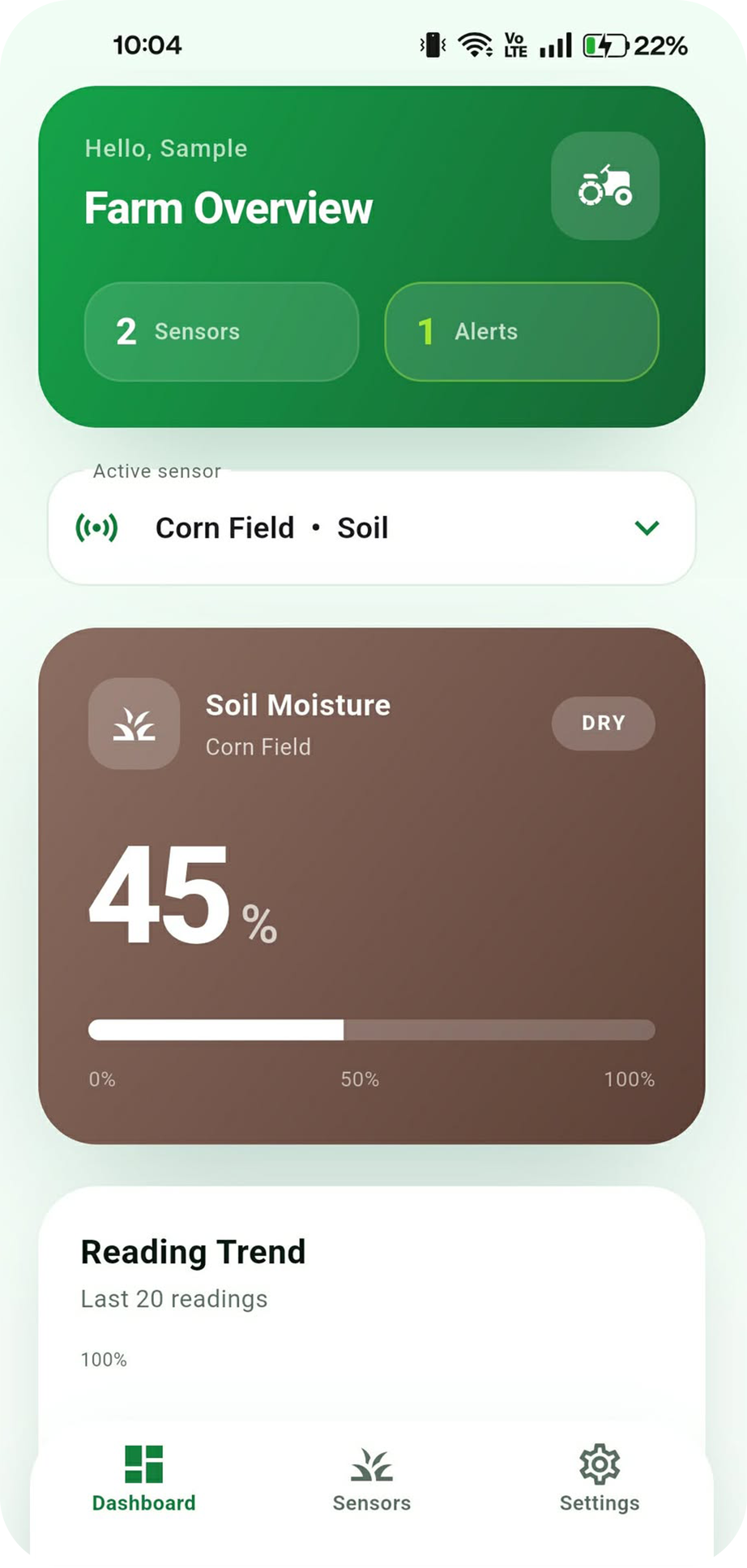
Purpose-built for the realities of rice farming — low power, long range, and readable under the sun.
Ultrasonic sensors measure the exact water depth in your paddies every few minutes — no more walking the bunds to check.
Capacitive probes buried at root depth track moisture percentage, so you irrigate based on the soil — not on habit.
A small solar panel and rechargeable battery keep the field node running continuously — no wiring, no electric bill.
Set your own minimum and maximum water levels. Get an instant push notification the moment readings go out of range.
Daily, weekly and seasonal graphs show how water and moisture behave — useful for planning the next cropping cycle.
ESP-based Wi-Fi provides wireless connectivity between the field node and the local network, enabling reliable data transmission within the available Wi-Fi range.
No technical background required. Install the node, open the app, and start reading your field.
Mount the solar-powered sensor node at the edge of your field and push the probes into the soil.
Water level and soil moisture are sampled automatically and continuously, day and night.
Readings travel over a long-range low-power link to the gateway, then up to the database.
Open the SAGIPfarmer app to see live values, trends, and alerts — anywhere you have a signal.
Every component was chosen for durability, low power draw, and availability in local electronics markets — so the system stays affordable and repairable.
Non-contact measurement from above the water surface — no corrosion, no clogging with mud or algae.
Corrosion-resistant sensing at root depth, giving stable readings across a full cropping season.
Handles sampling and transmits data over long distances with very little power consumption.
Charges through the day and keeps the node alive overnight and through cloudy weather.
How a single reading travels from your paddy to your screen.
Water management is the single biggest controllable factor in rice yield. SAGIPfarmer makes it measurable.
Irrigate only when the field actually needs it, instead of flooding on a fixed schedule.
Fewer unnecessary pumping hours means less diesel, less electricity, and less wear on equipment.
Maintaining the correct water depth at each growth stage supports tillering and grain filling.
Check every plot from home. Stop walking the bunds at dawn just to read a water gauge.
Breaches and sudden drainage happen at night too. Alerts reach you before the damage spreads.
Solar power means the node works in fields far from any electrical connection — and costs nothing to run.
Install the app directly on your phone. Pair it with your field node, set your water-level thresholds, and start receiving live readings in minutes.
Download APKNo. The field node runs entirely on its own solar panel and battery. Data is sent over a long-range low-power wireless link to a gateway, which is the only part that needs an internet connection. This means the sensors can be placed far from any power line or Wi-Fi router.
The ultrasonic water level sensor is accurate to within roughly ±1 cm under normal field conditions, and the capacitive soil moisture probe gives stable relative readings across the season. Both are calibrated before deployment so the numbers in the app match what you would measure manually.
Tap the Download APK button, then open the downloaded file from your notification bar or Files app. Android will ask you to allow installation from this source — enable it, tap Install, and the app will appear on your home screen. Since it is installed outside the Play Store, you may see a standard "unknown app" prompt, which is normal.
Yes. You can register several nodes and switch between plots from the dashboard. Each plot keeps its own thresholds, history, and alert settings, so a farmer managing multiple paddies can see everything in one place.
The node keeps measuring and the gateway stores readings locally. Once the connection returns, the buffered data is uploaded automatically, so there are no gaps in your history. The app also caches the last known readings so you can still view them offline.
The electronics enclosure is IP65-rated and mounted above the expected flood line, with sealed cable glands. The soil probe is buried and the ultrasonic sensor is non-contact, which removes the two most common failure points in wet-field instrumentation.